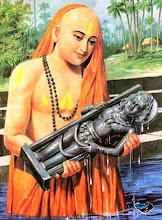
Source: www.dvaita.org
The prameya shloka composed by Sri Vyasa Teertharu, lays out nine important tenets of tattvavAda, a.k.a dvaita philosophy. The shloka seems to be simple on the surface but has a world of depth. It is very characteristic of Sri Vyasa Teertha to have digested the whole of the corpus of a large number of commentaries, original texts, glosses, etc., and presented a very pithy and yet easy-to-understand statement of the doctrine as presented in all of them.
In reading and analyzing the shloka that explains the prameya-s, one finds a faithful echo of many of Srimad Ananda Teertha's statements; Sri Vyasa Teertha compromises neither the nature nor the intensity of his master's unequivocal assertions. His prameya-shloka is thus a faithful recap of the subjects expounded upon by the previous scholars in the tradition, and it may be asserted that a correct understanding of the shloka is equivalent to a grasp of the fundamental tenets of Tattvavaada.
The shloka that lays out the nine prameya-s is :
shrImanmadhvamate hariH parataraH satyaM jagat tattvato
bhedo jIvagaNAH hareranucharAH nIchochcha bhAvangatAH |
muktirnaijasukhAnubhUtiramalAbhaktishcha tatsAdhanam
hyaxAditritayaM pramANamakhilAmnAyaikavedyo hariH ||
This may be split as:
shrIman madhva mate = In Sriman Madhva's doctrine
1> hariH parataraH = Hari (Vishnu) is Supreme
2> satyaM jagat = The world is true (real)
3> tattvataH bhedaH = The differences are real
4> jIvagaNAH hareH anucharAH = The classes of souls are followers of Hari
5> nIchochcha bhAvangatAH = And reach different ultimate states
6> muktiH naija sukha anubhUtiH = mukti (liberation) is the experience of the joy of one's own nature
7> amalA bhaktiH cha tat sAdhanaM = That is achieved by flawless devotion and [correct] understanding
8> axAditritayaM hi pramANaM = pratyaksha (observation), etc., are indeed the sources of knowledge
9> akhila AmnAya eka vedyo hariH = Hari alone is praised in all the Vedas.
The prameya shloka composed by Sri Vyasa Teertharu, lays out nine important tenets of tattvavAda, a.k.a dvaita philosophy. The shloka seems to be simple on the surface but has a world of depth. It is very characteristic of Sri Vyasa Teertha to have digested the whole of the corpus of a large number of commentaries, original texts, glosses, etc., and presented a very pithy and yet easy-to-understand statement of the doctrine as presented in all of them.
In reading and analyzing the shloka that explains the prameya-s, one finds a faithful echo of many of Srimad Ananda Teertha's statements; Sri Vyasa Teertha compromises neither the nature nor the intensity of his master's unequivocal assertions. His prameya-shloka is thus a faithful recap of the subjects expounded upon by the previous scholars in the tradition, and it may be asserted that a correct understanding of the shloka is equivalent to a grasp of the fundamental tenets of Tattvavaada.
The shloka that lays out the nine prameya-s is :
shrImanmadhvamate hariH parataraH satyaM jagat tattvato
bhedo jIvagaNAH hareranucharAH nIchochcha bhAvangatAH |
muktirnaijasukhAnubhUtiramalAbhaktishcha tatsAdhanam
hyaxAditritayaM pramANamakhilAmnAyaikavedyo hariH ||
This may be split as:
shrIman madhva mate = In Sriman Madhva's doctrine
1> hariH parataraH = Hari (Vishnu) is Supreme
2> satyaM jagat = The world is true (real)
3> tattvataH bhedaH = The differences are real
4> jIvagaNAH hareH anucharAH = The classes of souls are followers of Hari
5> nIchochcha bhAvangatAH = And reach different ultimate states
6> muktiH naija sukha anubhUtiH = mukti (liberation) is the experience of the joy of one's own nature
7> amalA bhaktiH cha tat sAdhanaM = That is achieved by flawless devotion and [correct] understanding
8> axAditritayaM hi pramANaM = pratyaksha (observation), etc., are indeed the sources of knowledge
9> akhila AmnAya eka vedyo hariH = Hari alone is praised in all the Vedas.
I. The first prameya
hariH parataraH = Hari (Vishnu) is Supreme
But there really is a lot more complexity than just the simple statement that Vishnu is Supreme. Notice, in particular, that the statement is "hariH parataraH," rather than "hariH paraH" or "hariH paramaH."
‘parataraH’ can be interpreted in several ways -- for instance:
That the indicated (Vishnu) is Superior even to the exalted, i.e., that there is a gradation among entities other than Vishnu, and He is completely above even the highest among them. That Vishnu is Superior even to those who have reached liberation; that is to say, Vishnu is superior not only to all other souls in this world (i.e., the unliberated ones), but also to all the souls that attain liberation. This also implies that no one merges with Him upon liberation as the state of superiority does not make sense if such a merger takes place.
That Vishnu is incomparably Superior in all respects, with respect to oneself and others. He is not just Superior by a slight margin, but is comprehensively so in every possible respect.
How so? As Srimad Ananda Tîrtha says:
nArAyaNAya paripUrNa guNArNavAya
vishvodaya sthitilayonniyati pradAya |
j~nAnapradAya vibudhAsurasaukhya duHkha
satkAraNAya vitatAya namonamaste |
Narayana, who is an ocean of complete virtues; Who causes the rise, sustenance, and fall of the universe; Who gives knowledge, and joy and suffering respectively to the good and the evil; Who is a Benevolent cause, and is completely beyond comprehension: Him, I salute over and over.
Thus, in all these respects, Vishnu is completely beyond oneself and others.
Authorities in support of these are many. For instance, the Bhagavad Gita, chapter fifteen, says:
dvAvimau purushhau loke xarashchAxara eva cha |
xaraH sarvANi bhUtAni kUtastho.axara uchyate || (15.16)
There are two types of sentients in the universe: the destructible and the indestructible. All creatures are destructible, while the anvil-like is called indestructible.
uttamaH purushhastvanyaH paramAtmetyudAh.rtaH |
yo lokatrayamAvishya bibhartyavyaya IshvaraH || (15.17)
The Supreme Being is different (from both the previous), and is thus called the `paramAtmA' (parama=Supreme; AtmA=Soul, sentient); He, who "invades" all three worlds and sustains them, though Himself unchanging, is Ishvara (God)
yasmAt xaramatIto.ahaM axarAdapi chottamaH |
ato.asmi loke vede cha prathitaH purushhottamaH || (15.18)
Because I (Krishna) am beyond the destructible, and am also Superior to the indestructible, thus am I called in the world, and in the Vedas, as the Purushottama (Supreme Being).
In his commentary upon the Bhagavad Gita (and in other places as well), Srimad Ananda Tîrtha says that the `kUTastha' refers to Lakshmi, the consort of Vishnu, who is the "abhimAni" (controller) of all nature; thus, she is like a changeless anvil which supports change in others, in being herself changeless, but supporting all of nature that is ever-changing.
Thus, Krishna is saying that there are two kinds of entities in the universe; one, the destructible, which includes all creatures, and the second the anvil-like, Lakshmi, who sustains all nature without suffering change. He, the Lord Vishnu, is different from both, and is thus called Paramatma. He, who inhabits all three worlds and sustains them, without suffering the changes and other travails of the universe, is called Ishvara (Lord).
But there really is a lot more complexity than just the simple statement that Vishnu is Supreme. Notice, in particular, that the statement is "hariH parataraH," rather than "hariH paraH" or "hariH paramaH."
‘parataraH’ can be interpreted in several ways -- for instance:
That the indicated (Vishnu) is Superior even to the exalted, i.e., that there is a gradation among entities other than Vishnu, and He is completely above even the highest among them. That Vishnu is Superior even to those who have reached liberation; that is to say, Vishnu is superior not only to all other souls in this world (i.e., the unliberated ones), but also to all the souls that attain liberation. This also implies that no one merges with Him upon liberation as the state of superiority does not make sense if such a merger takes place.
That Vishnu is incomparably Superior in all respects, with respect to oneself and others. He is not just Superior by a slight margin, but is comprehensively so in every possible respect.
How so? As Srimad Ananda Tîrtha says:
nArAyaNAya paripUrNa guNArNavAya
vishvodaya sthitilayonniyati pradAya |
j~nAnapradAya vibudhAsurasaukhya duHkha
satkAraNAya vitatAya namonamaste |
Narayana, who is an ocean of complete virtues; Who causes the rise, sustenance, and fall of the universe; Who gives knowledge, and joy and suffering respectively to the good and the evil; Who is a Benevolent cause, and is completely beyond comprehension: Him, I salute over and over.
Thus, in all these respects, Vishnu is completely beyond oneself and others.
Authorities in support of these are many. For instance, the Bhagavad Gita, chapter fifteen, says:
dvAvimau purushhau loke xarashchAxara eva cha |
xaraH sarvANi bhUtAni kUtastho.axara uchyate || (15.16)
There are two types of sentients in the universe: the destructible and the indestructible. All creatures are destructible, while the anvil-like is called indestructible.
uttamaH purushhastvanyaH paramAtmetyudAh.rtaH |
yo lokatrayamAvishya bibhartyavyaya IshvaraH || (15.17)
The Supreme Being is different (from both the previous), and is thus called the `paramAtmA' (parama=Supreme; AtmA=Soul, sentient); He, who "invades" all three worlds and sustains them, though Himself unchanging, is Ishvara (God)
yasmAt xaramatIto.ahaM axarAdapi chottamaH |
ato.asmi loke vede cha prathitaH purushhottamaH || (15.18)
Because I (Krishna) am beyond the destructible, and am also Superior to the indestructible, thus am I called in the world, and in the Vedas, as the Purushottama (Supreme Being).
In his commentary upon the Bhagavad Gita (and in other places as well), Srimad Ananda Tîrtha says that the `kUTastha' refers to Lakshmi, the consort of Vishnu, who is the "abhimAni" (controller) of all nature; thus, she is like a changeless anvil which supports change in others, in being herself changeless, but supporting all of nature that is ever-changing.
Thus, Krishna is saying that there are two kinds of entities in the universe; one, the destructible, which includes all creatures, and the second the anvil-like, Lakshmi, who sustains all nature without suffering change. He, the Lord Vishnu, is different from both, and is thus called Paramatma. He, who inhabits all three worlds and sustains them, without suffering the changes and other travails of the universe, is called Ishvara (Lord).
II. The second prameya
satyaM jagat = The universe is true (real)
That the universe is real, needs no separate proof at all; it is known from the evidence of one's everyday experience. How is such experience to be invalidated? Possibly by scripture. But what value to scripture when it negates the very source of knowledge that tells of the scripture's existence and worth in the first place?
As Srimad Ananda Tîrtha puts it:
na chAnubhava virodhe Agamasya prAmANyam |
Scripture has no validity if opposed to experience.
Thus, one finds that the universe cannot be considered an illusion, because, as Ananda Tîrtha says, again:
tatra pramANAbhAvAt|
-- There is no evidence for the same.
In the Bhagavad Gita, Krishna says:
asatyamapratishhThaM te jagadAhuranIshvaram |
aparaspara saMbhUtaM kimanyatkAmahaitukam || (16-8)
They (the evil) say that the universe is untrue (illusory), without basis [in reason / scripture], and without an Ishvara; that it has no mutual coherence, and is for nothing except lust-satisfaction.
Thus, the idea that the universe is illusory, or that it has no personal Creator, is strongly rejected in the Bhagavad Gita, among other places.
That the universe is real, needs no separate proof at all; it is known from the evidence of one's everyday experience. How is such experience to be invalidated? Possibly by scripture. But what value to scripture when it negates the very source of knowledge that tells of the scripture's existence and worth in the first place?
As Srimad Ananda Tîrtha puts it:
na chAnubhava virodhe Agamasya prAmANyam |
Scripture has no validity if opposed to experience.
Thus, one finds that the universe cannot be considered an illusion, because, as Ananda Tîrtha says, again:
tatra pramANAbhAvAt|
-- There is no evidence for the same.
In the Bhagavad Gita, Krishna says:
asatyamapratishhThaM te jagadAhuranIshvaram |
aparaspara saMbhUtaM kimanyatkAmahaitukam || (16-8)
They (the evil) say that the universe is untrue (illusory), without basis [in reason / scripture], and without an Ishvara; that it has no mutual coherence, and is for nothing except lust-satisfaction.
Thus, the idea that the universe is illusory, or that it has no personal Creator, is strongly rejected in the Bhagavad Gita, among other places.
III. The third prameya
tattvataH bhedaH = The differences are real
What is the nature of difference? Is the difference from something else inherent in an entity, or is it something apart from it? If it is something else, then we have an infinite regress.
For, if the difference is apart from the entity itself, then there must be a difference between the difference and the entity. Applying the same reasoning over and over, therefore, one has to postulate an infinite number of differences, showing the need for infinity of descriptions to capture difference. However, all this is avoided when one considers that the property of being different from every other entity, is part of the entity itself; as Ananda Tîrtha puts it:
padArthasvarUpatvAt bhedasya |
Because difference is the self-same nature of the entity (infinite regress does not occur).
Thus, because differences are the self-same properties of the entities of the universe themselves, and since the entities are real, the differences are also real.
What are the types of difference? There are five, given by:
jIveshvarabhidA chaiva jaDeshvara bhidA tathA |
jIvabhedo mithashchaiva jaDajIva bhidA tathA |
mithashcha jaDabhedo.ayaM prapancho bhedapanchakaH ||
-- paramopaniShad
The difference between:
1. Soul and the Creator,
2. Insentient and the Creator;
3. Any two souls,
4. Insentient and soul;
5. Any two insentients
– these five differences constitute the universe
But what about the statements in the Vedas that apparently show the identicalness of jîva (soul) and Ishvara (Creator)? Srimad Ananda Tîrtha says:
na hi kashchidapi abhedAgamaH | santi cha bhede sarvAgamAH |
There is never, ever, a statement of non-difference; all scripture shows difference, only.
This aspect is clarified in quotes like the following:
sarve vedA harerbhedaM sarvasmAt GYApayanti hi |
bhedaH svAtantryasArvaGYyasarvaishvaryAdikashcha saH |
svarUpameva bhedo.ayaM vyAvR^ittishcha svarUpatA |
sarvavyAvR^ittaye yasmAt svashabdo.ayaM prayujyate |
sarvavyAvR^ittatAmeva neti netyAdikA shrutiH |
vishhNorato vedAdanyA api sarvA na saMshayaH |
-- nArAyaNashrutiH
All the Vedas speak of the difference of Hari from all else. That difference lies in His independence, omniscience, and lordship over all, etc. His essential nature itself constitutes His difference from all. Essential nature is what distinguishes an entity from others. The word 'sva' (self) in `svarUpa' (self-nature) meaning essential nature is used in order to distinguish an entity from all others. The Shruti (BrhadaaraNyaka Upanishad) starting from "not thus, not thus," points to the difference of Vishnu from all else (from the sentients and the insentients, or from the destructible and the indestructible). All other Shruti texts also present the same truth. There is no doubt upon this point.
This point is also made in the Bhagavad Gita XV-15, where Krishna says:
vedaishcha sarvaiH ahameva vedyo |
All the Vedas and other scriptures tell of Me (Krishna) only.
Thus, they do no speak of an impersonal God, or of identicalness between jîva and Ishvara; they speak only of Him who is absolutely beyond -- and therefore different.
What is the nature of difference? Is the difference from something else inherent in an entity, or is it something apart from it? If it is something else, then we have an infinite regress.
For, if the difference is apart from the entity itself, then there must be a difference between the difference and the entity. Applying the same reasoning over and over, therefore, one has to postulate an infinite number of differences, showing the need for infinity of descriptions to capture difference. However, all this is avoided when one considers that the property of being different from every other entity, is part of the entity itself; as Ananda Tîrtha puts it:
padArthasvarUpatvAt bhedasya |
Because difference is the self-same nature of the entity (infinite regress does not occur).
Thus, because differences are the self-same properties of the entities of the universe themselves, and since the entities are real, the differences are also real.
What are the types of difference? There are five, given by:
jIveshvarabhidA chaiva jaDeshvara bhidA tathA |
jIvabhedo mithashchaiva jaDajIva bhidA tathA |
mithashcha jaDabhedo.ayaM prapancho bhedapanchakaH ||
-- paramopaniShad
The difference between:
1. Soul and the Creator,
2. Insentient and the Creator;
3. Any two souls,
4. Insentient and soul;
5. Any two insentients
– these five differences constitute the universe
But what about the statements in the Vedas that apparently show the identicalness of jîva (soul) and Ishvara (Creator)? Srimad Ananda Tîrtha says:
na hi kashchidapi abhedAgamaH | santi cha bhede sarvAgamAH |
There is never, ever, a statement of non-difference; all scripture shows difference, only.
This aspect is clarified in quotes like the following:
sarve vedA harerbhedaM sarvasmAt GYApayanti hi |
bhedaH svAtantryasArvaGYyasarvaishvaryAdikashch
svarUpameva bhedo.ayaM vyAvR^ittishcha svarUpatA |
sarvavyAvR^ittaye yasmAt svashabdo.ayaM prayujyate |
sarvavyAvR^ittatAmeva neti netyAdikA shrutiH |
vishhNorato vedAdanyA api sarvA na saMshayaH |
-- nArAyaNashrutiH
All the Vedas speak of the difference of Hari from all else. That difference lies in His independence, omniscience, and lordship over all, etc. His essential nature itself constitutes His difference from all. Essential nature is what distinguishes an entity from others. The word 'sva' (self) in `svarUpa' (self-nature) meaning essential nature is used in order to distinguish an entity from all others. The Shruti (BrhadaaraNyaka Upanishad) starting from "not thus, not thus," points to the difference of Vishnu from all else (from the sentients and the insentients, or from the destructible and the indestructible). All other Shruti texts also present the same truth. There is no doubt upon this point.
This point is also made in the Bhagavad Gita XV-15, where Krishna says:
vedaishcha sarvaiH ahameva vedyo |
All the Vedas and other scriptures tell of Me (Krishna) only.
Thus, they do no speak of an impersonal God, or of identicalness between jîva and Ishvara; they speak only of Him who is absolutely beyond -- and therefore different.
IV. The fourth prameya
jIvagaNAH hareH anucharAH = The classes of jîva-s are followers of Hari
Notice the use of `jIva-gaNAH' rather than `jIvAH'. The latter would simply mean "jîva-s," but by using the former, it is indicated that the jîva-s (souls) are not uniform, but are graded in quality.
How so?
The Taittirîya Upanishad says:
te ye shataM mAnushhA AnandAH |
sa eko manushhyagandharvANAmAnandaH |
...
te ye shataM devAnAmAnandAH |
sa eka indrasyA.a.anandaH |
etc.
A hundred times the enjoyment of a human - that is the enjoyment of a human-gandharva.
...
A hundred times the enjoyment of the deva-s - that is the enjoyment of Indra.
The Padma PuraNa also expounds upon that portion of the Taittiriya Upanishad, and other such Shruti quotes, as follows:
nR^ipAdyAH shatadhR^ityantA muktigA uttarottam |
guNaiH sarvaiH shataguNaiH modante iti hi shrutiH |
From the foremost-among-humans, to Brahma, the jîva-s attain mukti, with each step up qualifying for a hundred times the enjoyment of the previous -- thus indeed says the Shruti.
Thus, it is clearly indicated that all jîva-s do not have identical degrees of enjoyment. This can also be derived from inference, as a matter of fact:
Consider that all do not have identical positions of joy/suffering; why? If all jîva-s are inherently identical, what causes them to be different in their positions in reality?
1> If because of the Creator Lord Vishnu, then He may be accused of favoritism, malice, etc., and that is unacceptable
2> If because of past karma, then why is the past karma different for jîva-s that are identical? What caused those to be different?
3> If because the jîva-s themselves have different desires and thus choose different paths, how can they be called identical at all?
Thus, it follows from logic as well, that all jîva-s are not identical. But even granting that all jîva-s are not identical, why would any jîva do Vishnu's bidding? No one wants to be a servant; all want to be free. Yet, as Ananda Tîrtha puts it:
svatantramasvatantraM cha dvividhaM tattvamishhyate |
svatantro bhagavAn vishhNuH bhAvAbhAvau dvidhetarat ||
All entities are divided into two kinds -- the independent and the dependent. Lord Vishnu is independent, as He alone is different from both the positive and the negative.
The use of `bhAvAbhAvau dvidhetarat' is to indicate that Vishnu is not simply different from the things existing, but truly different in all respects. For instance, if one simply says that Vishnu is not like anything in the universe, there might be a suspicion as to whether He is similar to some inexistent entity that might be imagined.
Therefore, as only Vishnu is truly Independent in every respect, it follows that all else must follow His dictates, one way or another.
In the Bhagavad Gita, Krishna says:
IshvaraH sarvabhUtAnAM hR^iddeshe.arjuna tishhThati |
bhrAmayan sarvabhUtAni yantrArUDhAni mAyayA || (18.61)
The Creator resides in the hearts of all creatures; He makes them act, as though they were parts mounted on a machine.
Notice the use of `jIva-gaNAH' rather than `jIvAH'. The latter would simply mean "jîva-s," but by using the former, it is indicated that the jîva-s (souls) are not uniform, but are graded in quality.
How so?
The Taittirîya Upanishad says:
te ye shataM mAnushhA AnandAH |
sa eko manushhyagandharvANAmAnandaH |
...
te ye shataM devAnAmAnandAH |
sa eka indrasyA.a.anandaH |
etc.
A hundred times the enjoyment of a human - that is the enjoyment of a human-gandharva.
...
A hundred times the enjoyment of the deva-s - that is the enjoyment of Indra.
The Padma PuraNa also expounds upon that portion of the Taittiriya Upanishad, and other such Shruti quotes, as follows:
nR^ipAdyAH shatadhR^ityantA muktigA uttarottam |
guNaiH sarvaiH shataguNaiH modante iti hi shrutiH |
From the foremost-among-humans, to Brahma, the jîva-s attain mukti, with each step up qualifying for a hundred times the enjoyment of the previous -- thus indeed says the Shruti.
Thus, it is clearly indicated that all jîva-s do not have identical degrees of enjoyment. This can also be derived from inference, as a matter of fact:
Consider that all do not have identical positions of joy/suffering; why? If all jîva-s are inherently identical, what causes them to be different in their positions in reality?
1> If because of the Creator Lord Vishnu, then He may be accused of favoritism, malice, etc., and that is unacceptable
2> If because of past karma, then why is the past karma different for jîva-s that are identical? What caused those to be different?
3> If because the jîva-s themselves have different desires and thus choose different paths, how can they be called identical at all?
Thus, it follows from logic as well, that all jîva-s are not identical. But even granting that all jîva-s are not identical, why would any jîva do Vishnu's bidding? No one wants to be a servant; all want to be free. Yet, as Ananda Tîrtha puts it:
svatantramasvatantraM cha dvividhaM tattvamishhyate |
svatantro bhagavAn vishhNuH bhAvAbhAvau dvidhetarat ||
All entities are divided into two kinds -- the independent and the dependent. Lord Vishnu is independent, as He alone is different from both the positive and the negative.
The use of `bhAvAbhAvau dvidhetarat' is to indicate that Vishnu is not simply different from the things existing, but truly different in all respects. For instance, if one simply says that Vishnu is not like anything in the universe, there might be a suspicion as to whether He is similar to some inexistent entity that might be imagined.
Therefore, as only Vishnu is truly Independent in every respect, it follows that all else must follow His dictates, one way or another.
In the Bhagavad Gita, Krishna says:
IshvaraH sarvabhUtAnAM hR^iddeshe.arjuna tishhThati |
bhrAmayan sarvabhUtAni yantrArUDhAni mAyayA || (18.61)
The Creator resides in the hearts of all creatures; He makes them act, as though they were parts mounted on a machine.
V. The fifth prameya
nIchochcha bhAvangatAH = (The jîva-s are) headed for higher and lower states.
If the jîva-s are not inherently identical, one might wonder, do they yet reach the same ultimate state? If they do, then again one might accuse Vishnu of arbitrarily assigning all jîva-s to some fixed state, not recognizing the higher worth of some of them. But, as a matter of fact, it cannot be accepted that Vishnu is shown as flawed; as Srimad Ananda Tîrtha puts it:
dhyeyo nArAyaNaM nityaM sR^ishhTisthitya.ntakArakaH |
bhaktAnAM muktido nityamadhamaj~nAninAM tamaH ||
Worthy of contemplation is that NârâyaNa (Vishnu) who is Eternally the Cause of Creation, Sustenance, and Destruction; who is the Giver of mukti (liberation) to [His] devotees, and of eternal damnation to the evil.
But what is the scriptural basis for this assertion? After all, isn't it true that nearly every other doctrine denies the existence of eternal damnation?
In the Bhagavad Gita, Krishna says:
UrdhvaM gachchhanti sattvasthA madhye tishhThanti rAjasAH |
jaghanya guNa-vR^ittisthA adho gachchhanti tAmasAH || (14.18)
Upwards (to liberation) go those situated in sattva; the rAjasa-s stay in the middle; those situated in abominable qualities and deeds, the tâmasa-s, go to the lowest state.
But can it not be argued that the `sattvasthA' refers to qualities born out of attachment to other entities, rather than to innate qualities, thus showing that eternality of the states described is not indicated? Not so. In a previous chapter of the 'Gita itself, it is said:
traiguNya vishhayA vedA nistraiguNyo bhavArjuna |
nirdvandvo nityasattvastho niryogaxema AtmavAn || (2.45)
The Veda-s deal with the three qualities -- [knowing them], be without the three qualities, O Arjuna; be free of the pairs-of-opposites (love/hate, friendship/enmity, etc.), continuously situated in sattva, without concern for accrual or maintenance [of material entities], and given to contemplation of the Lord.
Now, the three guNa-s, or qualities are sattva, loosely translated as "goodness," rajas, translated similarly as "indifference," and tamas, also so translated as "evil." Now, Krishna is telling Arjuna to stay apart from the three guNa-s, and yet be always situated in sattva; does this make any sense?
It does, if one considers that guNa-s can be either acquired, or of one's own innate nature. Krishna is telling Arjuna to slough off all his acquired guNa-s, and be situated in the sattva that is his own nature (it cannot be the other way!).
But why can it not be argued that there are no qualities of one's own nature, at all, but all qualities are merely acquired by association?
For several reasons; some of them are: While there are instances of qualities being acquired, there is never an instance of the property of having qualities, itself being acquired.
An entity that has no quality similar (even in being opposite) to the one being acquired, cannot even form the association necessary to effect the acquisition.
Considering that the qualities of good, indifference, and evil cannot be said to reside in the Lord or in inanimate nature, the question arises as to where they are being acquired from.
Also, observe that the exact word `sattvasthA' used in "traiguNya vishhayA vedA" to denote the quality of one's own nature, is also used in "UrdhvaM gachchanti sattvasthA," thus showing that it is the inherent, rather than the overlaid, quality that is being referred to.
In any event, it is also seen that Krishna uses `rAjasAH' ("the indifferent") and `tAmasAH' ("the evil") as if they were inherent to the jîva-s described; there is no indication in His words that the qualities indicated are acquired ones.
Further support for the position is found in the sixteenth chapter:
tAnahaM dvishhataH krUrAn saMsAreshhu narAdhamAn |
xipAmi ajasraM ashubhAn AsurIshhveva yonishhu || (16.19)
AsurIM yonimApannA mUDhA janmani-janmani |
mAmaprApyaiva kaunteya tato yAntyadhamAM gatim || (16.20)
Those who are hateful towards me, are cruel and the worst humans in the world, them I forever hurl only into demonaic species.
Having reached evil species in birth after birth, the fools; completely failing to reach me, only they then go to the lowest state.
Notice the use of `eva' (meaning, "only," or "certainly") in the second line of the 20th verse; it is clearly stated that there are some who never reach mukti.
The IshAvAsya Upanishad says:
andhantamaH pravishanti ye.avidyAmupAsate |
Those who worship falsely enter into a blinding darkness (eternal hell).
If the jîva-s are not inherently identical, one might wonder, do they yet reach the same ultimate state? If they do, then again one might accuse Vishnu of arbitrarily assigning all jîva-s to some fixed state, not recognizing the higher worth of some of them. But, as a matter of fact, it cannot be accepted that Vishnu is shown as flawed; as Srimad Ananda Tîrtha puts it:
dhyeyo nArAyaNaM nityaM sR^ishhTisthitya.ntakArakaH |
bhaktAnAM muktido nityamadhamaj~nAninAM tamaH ||
Worthy of contemplation is that NârâyaNa (Vishnu) who is Eternally the Cause of Creation, Sustenance, and Destruction; who is the Giver of mukti (liberation) to [His] devotees, and of eternal damnation to the evil.
But what is the scriptural basis for this assertion? After all, isn't it true that nearly every other doctrine denies the existence of eternal damnation?
In the Bhagavad Gita, Krishna says:
UrdhvaM gachchhanti sattvasthA madhye tishhThanti rAjasAH |
jaghanya guNa-vR^ittisthA adho gachchhanti tAmasAH || (14.18)
Upwards (to liberation) go those situated in sattva; the rAjasa-s stay in the middle; those situated in abominable qualities and deeds, the tâmasa-s, go to the lowest state.
But can it not be argued that the `sattvasthA' refers to qualities born out of attachment to other entities, rather than to innate qualities, thus showing that eternality of the states described is not indicated? Not so. In a previous chapter of the 'Gita itself, it is said:
traiguNya vishhayA vedA nistraiguNyo bhavArjuna |
nirdvandvo nityasattvastho niryogaxema AtmavAn || (2.45)
The Veda-s deal with the three qualities -- [knowing them], be without the three qualities, O Arjuna; be free of the pairs-of-opposites (love/hate, friendship/enmity, etc.), continuously situated in sattva, without concern for accrual or maintenance [of material entities], and given to contemplation of the Lord.
Now, the three guNa-s, or qualities are sattva, loosely translated as "goodness," rajas, translated similarly as "indifference," and tamas, also so translated as "evil." Now, Krishna is telling Arjuna to stay apart from the three guNa-s, and yet be always situated in sattva; does this make any sense?
It does, if one considers that guNa-s can be either acquired, or of one's own innate nature. Krishna is telling Arjuna to slough off all his acquired guNa-s, and be situated in the sattva that is his own nature (it cannot be the other way!).
But why can it not be argued that there are no qualities of one's own nature, at all, but all qualities are merely acquired by association?
For several reasons; some of them are: While there are instances of qualities being acquired, there is never an instance of the property of having qualities, itself being acquired.
An entity that has no quality similar (even in being opposite) to the one being acquired, cannot even form the association necessary to effect the acquisition.
Considering that the qualities of good, indifference, and evil cannot be said to reside in the Lord or in inanimate nature, the question arises as to where they are being acquired from.
Also, observe that the exact word `sattvasthA' used in "traiguNya vishhayA vedA" to denote the quality of one's own nature, is also used in "UrdhvaM gachchanti sattvasthA," thus showing that it is the inherent, rather than the overlaid, quality that is being referred to.
In any event, it is also seen that Krishna uses `rAjasAH' ("the indifferent") and `tAmasAH' ("the evil") as if they were inherent to the jîva-s described; there is no indication in His words that the qualities indicated are acquired ones.
Further support for the position is found in the sixteenth chapter:
tAnahaM dvishhataH krUrAn saMsAreshhu narAdhamAn |
xipAmi ajasraM ashubhAn AsurIshhveva yonishhu || (16.19)
AsurIM yonimApannA mUDhA janmani-janmani |
mAmaprApyaiva kaunteya tato yAntyadhamAM gatim || (16.20)
Those who are hateful towards me, are cruel and the worst humans in the world, them I forever hurl only into demonaic species.
Having reached evil species in birth after birth, the fools; completely failing to reach me, only they then go to the lowest state.
Notice the use of `eva' (meaning, "only," or "certainly") in the second line of the 20th verse; it is clearly stated that there are some who never reach mukti.
The IshAvAsya Upanishad says:
andhantamaH pravishanti ye.avidyAmupAsate |
Those who worship falsely enter into a blinding darkness (eternal hell).
VI. The sixth prameya
muktiH naija sukha anubhUtiH =
Liberation is the complete experience of the joys of one's own nature.
Consider what liberation might be. If it is to mean ceaseless bliss, then one has to wonder what the source of such ceaseless bliss might be. If the source is something in the material world, then the bliss cannot possibly be eternal, and must cease.
If the source of bliss is the Lord, then it could be eternal, but He could be accused of partisan behavior, because He evidently gives such bliss to some but not to others.
Therefore, the joy experienced by the soul in its state of liberation can only properly be that of its own nature.
In the Bhâgavata PurâNa, it is said:
muktirhitvAnyathArUpaM svarUpeNa vyavasthitiH |
Mukti is when other-attributes (those not of one's self-same nature) are given up, and [one is] situated in one's own nature.
Similarly, Srimad Ananda Tîrtha quotes from the R^ig Veda:
paranjyotirupasampadya svena rUpeNAbhinishhpadyate |
[In mukti], having earned the form of the highest brilliance, [one experiences] one's own form to an excellent degree
But what is the significance of the prameya-shloka saying 'anu-bhUtiH' (excellent experiencing, or complete experiencing) rather than just 'bhUtiH' (for experiencing)? Is there any state where one may experience only part of the joy of one's own nature?
In his salutation before commencing the commentary upon the Vishnu-tattva-vinirNaya, Sri Jayatîrtha has said:
svApaM prApayati shramApahR^itaye kalpAvasAne cha yaH |
taM devaM pitaraM patiM gurutamaM vande ramAvallabham ||
He, who gives sleep, to remove the stress of work, at the end of the kalpa as well; that Deity, Father, Lord, the highest among guru-s, the Lord of Ramâ (Lakshmi), I salute.
In the state of deep sleep, a person has no contact with the senses, and thus, sense-based satisfaction does not exist. However, it is a matter of common experience that sleep is very satisfying, and that upon awakening, one always recalls it to have been a very pleasing experience. So where is the joy of sleep coming from? Since it cannot be from association with external entities, it has to be from the jîva-s own nature.
The other state where a jîva may experience partial joy of its own nature, is in the interregnum between kalpa-s, when Creation does not exist. At that time, too, there is no contact with material nature, and the jîva experiences a state similar to deep sleep.
Thus, Sri Jayatîrtha worships Lord Vishnu as the remover of stress, during sleep, as well as at the end of the Kalpa.
Liberation is the complete experience of the joys of one's own nature.
Consider what liberation might be. If it is to mean ceaseless bliss, then one has to wonder what the source of such ceaseless bliss might be. If the source is something in the material world, then the bliss cannot possibly be eternal, and must cease.
If the source of bliss is the Lord, then it could be eternal, but He could be accused of partisan behavior, because He evidently gives such bliss to some but not to others.
Therefore, the joy experienced by the soul in its state of liberation can only properly be that of its own nature.
In the Bhâgavata PurâNa, it is said:
muktirhitvAnyathArUpaM svarUpeNa vyavasthitiH |
Mukti is when other-attributes (those not of one's self-same nature) are given up, and [one is] situated in one's own nature.
Similarly, Srimad Ananda Tîrtha quotes from the R^ig Veda:
paranjyotirupasampadya svena rUpeNAbhinishhpadyate |
[In mukti], having earned the form of the highest brilliance, [one experiences] one's own form to an excellent degree
But what is the significance of the prameya-shloka saying 'anu-bhUtiH' (excellent experiencing, or complete experiencing) rather than just 'bhUtiH' (for experiencing)? Is there any state where one may experience only part of the joy of one's own nature?
In his salutation before commencing the commentary upon the Vishnu-tattva-vinirNaya, Sri Jayatîrtha has said:
svApaM prApayati shramApahR^itaye kalpAvasAne cha yaH |
taM devaM pitaraM patiM gurutamaM vande ramAvallabham ||
He, who gives sleep, to remove the stress of work, at the end of the kalpa as well; that Deity, Father, Lord, the highest among guru-s, the Lord of Ramâ (Lakshmi), I salute.
In the state of deep sleep, a person has no contact with the senses, and thus, sense-based satisfaction does not exist. However, it is a matter of common experience that sleep is very satisfying, and that upon awakening, one always recalls it to have been a very pleasing experience. So where is the joy of sleep coming from? Since it cannot be from association with external entities, it has to be from the jîva-s own nature.
The other state where a jîva may experience partial joy of its own nature, is in the interregnum between kalpa-s, when Creation does not exist. At that time, too, there is no contact with material nature, and the jîva experiences a state similar to deep sleep.
Thus, Sri Jayatîrtha worships Lord Vishnu as the remover of stress, during sleep, as well as at the end of the Kalpa.
VII. The seventh prameya
amalA bhaktiH cha tat sAdhanaM =
That (moksha) is achieved by flawless devotion and [correct] understanding
But why is moksha (liberation) even desirable? Why should one not focus on achieving other ends? There are said to be four ends that one can strive for: dharma, or religious/spiritual merit; artha, or wealth; kAma, or sensory satisfaction; and moksha (mukti), or liberation from the world. Of these, why is moksha the highest?
anityatvAtsaduHkhatvAnna dharmAdyAH paraM sukham |
moxa eva parAna.ndaH saMsAre parivartatAm ||
-- mahAbhArata
Because dharma, etc., are non-everlasting, and are always mixed with pain; dharma, etc., are not the supreme benefit; moksha alone is the supreme joy, and is beyond the ken of the world.
That gives the reason why it is that moksha should be the primary objective of one's striving, in preference to the other types of possible benefits.
Srimad Ananda Tîrtha states:
mokshashcha vishhNuprasAdena vinA na labhyate |
Moksha and [the other ends] are not obtained without Vishnu's grace.
That mukti is achieved by the grace of Vishnu, and not achieved otherwise, is known clearly from several sources, for instance:
aj~nAnAM j~nAnado vishhNoH j~nAninAM moxadashcha saH |
Ana.ndadashcha muktAnAM sa evaiko janArdanaH ||
-- skAnda-purANa
To the un-knowing, Vishnu gives knowledge; to the knowing, He gives moksha; To the liberated, He gives joy, and He alone is fit for all to worship.
And also:
ye tu sarvANi karmANi mayi sanyasya matparaH |
ananyenaiva yogena mAM dhyAyanta upAsate || (12.6)
teshhAmahaM samuddhartA mR^ityusaMsArasAgarAt |
bhavAMi na chirAtpArtha mayyAveshitachetasAm || (12.7)
-- bhagavadgItA
Those who, having surrendered all actions unto me, without fail, perform (bhakti)-yoga, meditate upon and worship me; For them, who have instilled Me into their consciousness completely, I am the swift rescuer from the ocean of death and material existence.
And also:
yasya prasAdAtparamArtirUpAdasmAtsaMsArAnmuchyate nApareNa |
nArAyaNo.asau paramo vichi.ntyo mumuxubhiH karmapAshAdamushhmAt ||
-- nArAyaNashrutiH
By whose grace alone, the greatly suffering are rid of the world, and not otherwise; He is NârâyaNa, the Supreme, and the one fit to be contemplated upon by those who seek to be liberated from the binds of karma.
What is devotion? In the Bhagavad Gita, Krishna has said:
yo mAM evaM asammUDho jAnAti purushhottamaM |
sa sarvavit bhajati mAM sarvabhAvena bhArata || (15.19)
He who knows Me, without a doubt, as being the Supreme Person; he is considered to know all [the scriptures], and worships Me in all possible ways, O Bhârata (Arjuna).
Thus, it is necessary to know the Lord's qualities as they are, for otherwise, a proper devotion to Him is not attained. In the previous verses to this one (which were cited in connection with the first prameya), Krishna has defined the exact meaning of `purushhottama' as being One who is different from, and vastly Superior to, the destructible and the indestructible.
That (moksha) is achieved by flawless devotion and [correct] understanding
But why is moksha (liberation) even desirable? Why should one not focus on achieving other ends? There are said to be four ends that one can strive for: dharma, or religious/spiritual merit; artha, or wealth; kAma, or sensory satisfaction; and moksha (mukti), or liberation from the world. Of these, why is moksha the highest?
anityatvAtsaduHkhatvAnna dharmAdyAH paraM sukham |
moxa eva parAna.ndaH saMsAre parivartatAm ||
-- mahAbhArata
Because dharma, etc., are non-everlasting, and are always mixed with pain; dharma, etc., are not the supreme benefit; moksha alone is the supreme joy, and is beyond the ken of the world.
That gives the reason why it is that moksha should be the primary objective of one's striving, in preference to the other types of possible benefits.
Srimad Ananda Tîrtha states:
mokshashcha vishhNuprasAdena vinA na labhyate |
Moksha and [the other ends] are not obtained without Vishnu's grace.
That mukti is achieved by the grace of Vishnu, and not achieved otherwise, is known clearly from several sources, for instance:
aj~nAnAM j~nAnado vishhNoH j~nAninAM moxadashcha saH |
Ana.ndadashcha muktAnAM sa evaiko janArdanaH ||
-- skAnda-purANa
To the un-knowing, Vishnu gives knowledge; to the knowing, He gives moksha; To the liberated, He gives joy, and He alone is fit for all to worship.
And also:
ye tu sarvANi karmANi mayi sanyasya matparaH |
ananyenaiva yogena mAM dhyAyanta upAsate || (12.6)
teshhAmahaM samuddhartA mR^ityusaMsArasAgarAt |
bhavAMi na chirAtpArtha mayyAveshitachetasAm || (12.7)
-- bhagavadgItA
Those who, having surrendered all actions unto me, without fail, perform (bhakti)-yoga, meditate upon and worship me; For them, who have instilled Me into their consciousness completely, I am the swift rescuer from the ocean of death and material existence.
And also:
yasya prasAdAtparamArtirUpAdasmAtsaMsArAnmuchy
nArAyaNo.asau paramo vichi.ntyo mumuxubhiH karmapAshAdamushhmAt ||
-- nArAyaNashrutiH
By whose grace alone, the greatly suffering are rid of the world, and not otherwise; He is NârâyaNa, the Supreme, and the one fit to be contemplated upon by those who seek to be liberated from the binds of karma.
What is devotion? In the Bhagavad Gita, Krishna has said:
yo mAM evaM asammUDho jAnAti purushhottamaM |
sa sarvavit bhajati mAM sarvabhAvena bhArata || (15.19)
He who knows Me, without a doubt, as being the Supreme Person; he is considered to know all [the scriptures], and worships Me in all possible ways, O Bhârata (Arjuna).
Thus, it is necessary to know the Lord's qualities as they are, for otherwise, a proper devotion to Him is not attained. In the previous verses to this one (which were cited in connection with the first prameya), Krishna has defined the exact meaning of `purushhottama' as being One who is different from, and vastly Superior to, the destructible and the indestructible.
How and why may devotion to the Lord be possibly flawed?
If one considers oneself to (also) be the Lord, or
to be the same as He, or to be even superior, or
if one considers another than the Lord to be Supreme, or such, then
one's devotion is flawed, and will not result in liberation. As Sri Ananda Tîrtha puts it:
jIvAbhedA nirguNatvaM apUrNaguNatA tathA |
sAmyAdhikyaM tadanyeshhAM bhedastadgata eva cha |
prAdurbhAva viparyAsaH tadbhaktadveshha eva cha |
tatpramANani.ndAM cha doshhA ete.akhilA matAH |
etairvihIna yA bhaktiH sA bhaktiriti uchyate ||
-- mahAbhArata-tAtparya-nirNaya
The flaws in devotion are:
1) jIvAbhedA - to consider there to exist intrinsic abheda between jîva(s) and the Lord
2) nirguNatvaM - to consider the Lord as attributeless
3) apUrNaguNatA - to consider the Lord as having limited attributes (quality and/or quantity)
4) sAmya - to consider oneself or some other entity to be equal to Him
5) AdhikyaM tadanyeshhAM - to consider onself or some other entity to be superior to the Lord
6) bhedastadgataeva cha - To consider His incarnations to be different from Him (or from each other) in worth, value, etc.
7) prAdurbhAvaviparyAsaH - To consider the Lord as being born like ordinary mortals during His incarnations
8) tadbhaktadveshha - To hate His devotees
9) tatpramANa ni.ndAM cha - To condemn/hate the primordial pramANa-s (Shruti, etc.)
Devotion that is devoid of above flaws is called Bhakti.
Srimad Acharya says that just as a king puts down those subjects of his who are disloyal to him, the Lord puts down those jîva-s who refuse to be loyal to Him.
Disloyalty to the throne can take several forms -- refusing to acknowledge the king, considering oneself or another to (also) be the king or as powerful as the king, condemning the servants of the king, speaking ill of the dictates of the king, etc.
So also, disloyalty to the Lord can be as atheism, a mistaken belief in identity with the Lord, the worship of other deities as the Supreme Lord, attempting to hurt or harm devotees of the Lord, condemning the scriptures, etc.
And while a human king is limited in his power, and is also bounded in his influence by space and time, the Lord faces no such limitation. Thus, whilst there exists the possibility of escaping punishment in spite of defying a king, there is none such when defying the Lord.
It is seen that all of these flaws may be considered instances where one does not understand the Lord as the Purushottama, and these are all the possible instances where proper understanding of Him as being so may lapse. Thus, when such lapses are not found, bhakti exists.
Quoting Srimad Ananda Tîrtha again:
j~nAnapUrvaM parassnehaH nityo bhakti itIryate |
Continuous/ceaseless affection for the Lord, which is accompanied by the proper knowledge, is called devotion.
Sri Jayatîrtha offers the following equivalent but more explicit definition:
anantakalyANaguNatvaj~nAnapUrvakaH antrAyasahasreNApi
apratibaddhaH prema pravAhaH bhaktiH |
Knowing the Lord as full of completely auspicious infinite attributes, and maintaining a stream of unperturbed love towards Him even if there be a thousand obstacles or problems, is called bhakti.
That is to say, one is not to have "devotion" when things are going well for oneself, but criticize Him when they are not, etc., as one is apt to do.
If one considers oneself to (also) be the Lord, or
to be the same as He, or to be even superior, or
if one considers another than the Lord to be Supreme, or such, then
one's devotion is flawed, and will not result in liberation. As Sri Ananda Tîrtha puts it:
jIvAbhedA nirguNatvaM apUrNaguNatA tathA |
sAmyAdhikyaM tadanyeshhAM bhedastadgata eva cha |
prAdurbhAva viparyAsaH tadbhaktadveshha eva cha |
tatpramANani.ndAM cha doshhA ete.akhilA matAH |
etairvihIna yA bhaktiH sA bhaktiriti uchyate ||
-- mahAbhArata-tAtparya-nirNaya
The flaws in devotion are:
1) jIvAbhedA - to consider there to exist intrinsic abheda between jîva(s) and the Lord
2) nirguNatvaM - to consider the Lord as attributeless
3) apUrNaguNatA - to consider the Lord as having limited attributes (quality and/or quantity)
4) sAmya - to consider oneself or some other entity to be equal to Him
5) AdhikyaM tadanyeshhAM - to consider onself or some other entity to be superior to the Lord
6) bhedastadgataeva cha - To consider His incarnations to be different from Him (or from each other) in worth, value, etc.
7) prAdurbhAvaviparyAsaH - To consider the Lord as being born like ordinary mortals during His incarnations
8) tadbhaktadveshha - To hate His devotees
9) tatpramANa ni.ndAM cha - To condemn/hate the primordial pramANa-s (Shruti, etc.)
Devotion that is devoid of above flaws is called Bhakti.
Srimad Acharya says that just as a king puts down those subjects of his who are disloyal to him, the Lord puts down those jîva-s who refuse to be loyal to Him.
Disloyalty to the throne can take several forms -- refusing to acknowledge the king, considering oneself or another to (also) be the king or as powerful as the king, condemning the servants of the king, speaking ill of the dictates of the king, etc.
So also, disloyalty to the Lord can be as atheism, a mistaken belief in identity with the Lord, the worship of other deities as the Supreme Lord, attempting to hurt or harm devotees of the Lord, condemning the scriptures, etc.
And while a human king is limited in his power, and is also bounded in his influence by space and time, the Lord faces no such limitation. Thus, whilst there exists the possibility of escaping punishment in spite of defying a king, there is none such when defying the Lord.
It is seen that all of these flaws may be considered instances where one does not understand the Lord as the Purushottama, and these are all the possible instances where proper understanding of Him as being so may lapse. Thus, when such lapses are not found, bhakti exists.
Quoting Srimad Ananda Tîrtha again:
j~nAnapUrvaM parassnehaH nityo bhakti itIryate |
Continuous/ceaseless affection for the Lord, which is accompanied by the proper knowledge, is called devotion.
Sri Jayatîrtha offers the following equivalent but more explicit definition:
anantakalyANaguNatvaj~nAnapUrvakaH antrAyasahasreNApi
apratibaddhaH prema pravAhaH bhaktiH |
Knowing the Lord as full of completely auspicious infinite attributes, and maintaining a stream of unperturbed love towards Him even if there be a thousand obstacles or problems, is called bhakti.
That is to say, one is not to have "devotion" when things are going well for oneself, but criticize Him when they are not, etc., as one is apt to do.
VIII. The eighth prameya
akShAditritayaM hi pramANaM = The triad of pratyaksha, etc., are indeed the sources of valid knowledge
The word `pramANa' is defined by Ananda Tîrtha using the statement:
yathArthaM pramANam |
That which is as-is, is a pramANa
This is a definition of the word pramANa. But what is a definition of something? What does it mean to define something? If there is an entity to be defined, which we refer to as a lakshya, then a property called a lakshaNa, must be given for it; this statement of a property is a definition. But what kind of property is suitable for use in a definition?
Sri Jayatîrtha says:
lakshyamAtravyApako dharmo lakshaNam
A property that extends only to the entity to be described, is a lakshaNa.
Consider the case of a cow. If one has to specify what one means by `cow', then how does one do so? One cannot say that cows have four feet, because many animals do, and this specification has the flaw of "ati-vyApti" -- excess over legitimate domain.
One cannot say that cows are white with brown spots on their skin, because not all cows are like that, and this specification carries the flaw of "a-vyApti," or not extending to all cases of the defined.
A proper lakshaNa is given by:
sAsnAdimAn gauH |
A cow is that which has a flap of loose skin hanging at its throat, etc. (Other properties like four-leggedness, etc., to be added in support of this one.)
Thus, just as the property of having a loose flap of skin at the throat is unique to the cow and is thus a lakshaNa for a cow, the property of being "yathArtha" -- as-is, is unique to the pramANa, and is a lakshaNa for a pramANa. Therefore, the pramANa-lakshaNa is given by "yathArthaM pramANam" rather than in any other way.
Srimad Ananda Tîrtha further states:
tat dvividham | kevalaM anupramANaM cha |
That (pramANa) is of two kinds -- kevala-, and anu-pramANa.
yathArthaj~nAnaM kevalam |
tatsAdhanaM anupramANam |
Knowledge which is as-is, is called kevala; The source of that (the previous) is anu-pramANa.
And after some further discussion about kevala-pramANa, he says:
anupramANaM trividham | pratyaxam anumAnam AgamaM iti |
anu-pramANa is of three types: pratyaksha, anumAna, and Agama -- thus.
Generally speaking, the word `pramANa' is often applied to refer to this kind -- in the prameya-shloka, Sri Vyâsa Tîrtha applies it so. So in fact, the three kinds of anu-pramANa are what are mentioned as "the triad of pratyaksha, etc.," in the verse.
nirdoshhArthendriya sannikarshaH pratyaksham |
Flawless interaction between a sense-organ and an entity in its domain, is called pratyaksha.
In another context, Sri Madhva has also quoted the Brahma-Tarka statement:
vishhayAn pratisthitaM hi akshaM pratyakshaM iti kIrtitam |
A sense-organ that is flawlessly situated upon a subject of its observation, is known as pratyaksha.
Similarly, he gives a quote from there saying:
tarko adushhTaH tathA anumA |
Inference that is without flaw constitutes logic.
What are the flaws of inference?
AtmAnyonyAshraya chakrakAnavasthAkalpanAgaurava
shrutadR^ishhTahAnAdayodUshhaNAnumA |
AtmAshraya, anyonyAshraya, chakrakAshraya, anavasthA, kalpanAgaurava, shruta-hAna, dR^ishhTa-hAna, etc., are flaws of inference.
Similarly, Agama is defined as:
nirdoshhaH shabdaH AgamaH |
Flawless textual evidence is Agama.
Thus, in every case, it is not necessary for something to have a certain positive qualification in order to qualify as a pramANa -- the mere lack of a flaw is considered sufficient. That is to say, the quality of being a pramANa -- which is called prAmANya -- is inherent in a source of knowledge, unless such property is vitiated by a flaw. Any source of knowledge is assumed to convey as-is (exact) information unless there is reason to believe otherwise.
But how? Certain schools of thought hold that all sources of knowledge are flawed by themselves, and that thus, it is not possible to qualify a source of knowledge as a pramANa except upon support from another source. Srimad Ananda Tîrtha says:
prAmANyaM cha svata eva | anyathA.anavasthAnAt |
The quality of being a pramANa is of the self-same nature (of the source) only; otherwise, an infinite regress results.
Just consider -- if any one pramANa has to be qualified by another in order to be effective, then there has to be a third to qualify the second, and so on, with no end. There cannot ever be any valid knowledge at all, in that case. To avoid that situation, one must accept that the property of validity is inherent in a source of knowledge, unless such is vitiated by flaw.
But how does one know that there is a flaw somewhere? What is the source of such knowledge of flaw? Srimad Achârya states:
bahupramANavirodhe chaikasyAprAmANyaM dR^ishhTaM shuktirajatAdau |
When many pramANa-s (or a stronger pramANa) oppose(s) a single source, then the latter's a-prAmANya, or non-validity, is seen, as in the case of the shell appearing as silver.
A famous example given in Vedanta is that of a sea-shell being seen in poor light, and of its glint in that light appearing to be that of silver, thus leading to the mistaking of the shell for a silver object. If one picks up the shell and observes it not to be made of silver, then the stronger evidence of one's closer and careful observation is used to dismiss the earlier one as unsatisfactory.
But it may be argued that a-prAmANya is known when a flaw is seen; so what's this about opposing a stronger or many pramANa-s, etc.?
na cha doshhajanyatvAdeva durbalatvamiti virodhaH |
bahupramANaviruddhAnAM doshhajanyatvaniyamAt |
It is not to be said that the previous is incorrect because a-prAmANya is always born of flaw; for there exists a rule that opposition to many (or stronger) pramANa(s) is born of flaw.
Further clarification:
doshhajanyatvaM cha balavatpramANavirodhAdeva j~nAyate |
The fact of the source being vitiated by flaw, is known only by its opposition to stronger evidence.
Coming back to the prameya-shloka quote "akshAditrayaM hi pramANaM," there are two parts to the issue:
That pratyaksha, etc., are pramANa-s, and may not be dismissed as not being so.
That there exists no source of exact knowledge which is not covered under these three.
The word `pramANa' is defined by Ananda Tîrtha using the statement:
yathArthaM pramANam |
That which is as-is, is a pramANa
This is a definition of the word pramANa. But what is a definition of something? What does it mean to define something? If there is an entity to be defined, which we refer to as a lakshya, then a property called a lakshaNa, must be given for it; this statement of a property is a definition. But what kind of property is suitable for use in a definition?
Sri Jayatîrtha says:
lakshyamAtravyApako dharmo lakshaNam
A property that extends only to the entity to be described, is a lakshaNa.
Consider the case of a cow. If one has to specify what one means by `cow', then how does one do so? One cannot say that cows have four feet, because many animals do, and this specification has the flaw of "ati-vyApti" -- excess over legitimate domain.
One cannot say that cows are white with brown spots on their skin, because not all cows are like that, and this specification carries the flaw of "a-vyApti," or not extending to all cases of the defined.
A proper lakshaNa is given by:
sAsnAdimAn gauH |
A cow is that which has a flap of loose skin hanging at its throat, etc. (Other properties like four-leggedness, etc., to be added in support of this one.)
Thus, just as the property of having a loose flap of skin at the throat is unique to the cow and is thus a lakshaNa for a cow, the property of being "yathArtha" -- as-is, is unique to the pramANa, and is a lakshaNa for a pramANa. Therefore, the pramANa-lakshaNa is given by "yathArthaM pramANam" rather than in any other way.
Srimad Ananda Tîrtha further states:
tat dvividham | kevalaM anupramANaM cha |
That (pramANa) is of two kinds -- kevala-, and anu-pramANa.
yathArthaj~nAnaM kevalam |
tatsAdhanaM anupramANam |
Knowledge which is as-is, is called kevala; The source of that (the previous) is anu-pramANa.
And after some further discussion about kevala-pramANa, he says:
anupramANaM trividham | pratyaxam anumAnam AgamaM iti |
anu-pramANa is of three types: pratyaksha, anumAna, and Agama -- thus.
Generally speaking, the word `pramANa' is often applied to refer to this kind -- in the prameya-shloka, Sri Vyâsa Tîrtha applies it so. So in fact, the three kinds of anu-pramANa are what are mentioned as "the triad of pratyaksha, etc.," in the verse.
nirdoshhArthendriya sannikarshaH pratyaksham |
Flawless interaction between a sense-organ and an entity in its domain, is called pratyaksha.
In another context, Sri Madhva has also quoted the Brahma-Tarka statement:
vishhayAn pratisthitaM hi akshaM pratyakshaM iti kIrtitam |
A sense-organ that is flawlessly situated upon a subject of its observation, is known as pratyaksha.
Similarly, he gives a quote from there saying:
tarko adushhTaH tathA anumA |
Inference that is without flaw constitutes logic.
What are the flaws of inference?
AtmAnyonyAshraya chakrakAnavasthAkalpanAgaurava
shrutadR^ishhTahAnAdayodUshhaNAnumA |
AtmAshraya, anyonyAshraya, chakrakAshraya, anavasthA, kalpanAgaurava, shruta-hAna, dR^ishhTa-hAna, etc., are flaws of inference.
Similarly, Agama is defined as:
nirdoshhaH shabdaH AgamaH |
Flawless textual evidence is Agama.
Thus, in every case, it is not necessary for something to have a certain positive qualification in order to qualify as a pramANa -- the mere lack of a flaw is considered sufficient. That is to say, the quality of being a pramANa -- which is called prAmANya -- is inherent in a source of knowledge, unless such property is vitiated by a flaw. Any source of knowledge is assumed to convey as-is (exact) information unless there is reason to believe otherwise.
But how? Certain schools of thought hold that all sources of knowledge are flawed by themselves, and that thus, it is not possible to qualify a source of knowledge as a pramANa except upon support from another source. Srimad Ananda Tîrtha says:
prAmANyaM cha svata eva | anyathA.anavasthAnAt |
The quality of being a pramANa is of the self-same nature (of the source) only; otherwise, an infinite regress results.
Just consider -- if any one pramANa has to be qualified by another in order to be effective, then there has to be a third to qualify the second, and so on, with no end. There cannot ever be any valid knowledge at all, in that case. To avoid that situation, one must accept that the property of validity is inherent in a source of knowledge, unless such is vitiated by flaw.
But how does one know that there is a flaw somewhere? What is the source of such knowledge of flaw? Srimad Achârya states:
bahupramANavirodhe chaikasyAprAmANyaM dR^ishhTaM shuktirajatAdau |
When many pramANa-s (or a stronger pramANa) oppose(s) a single source, then the latter's a-prAmANya, or non-validity, is seen, as in the case of the shell appearing as silver.
A famous example given in Vedanta is that of a sea-shell being seen in poor light, and of its glint in that light appearing to be that of silver, thus leading to the mistaking of the shell for a silver object. If one picks up the shell and observes it not to be made of silver, then the stronger evidence of one's closer and careful observation is used to dismiss the earlier one as unsatisfactory.
But it may be argued that a-prAmANya is known when a flaw is seen; so what's this about opposing a stronger or many pramANa-s, etc.?
na cha doshhajanyatvAdeva durbalatvamiti virodhaH |
bahupramANaviruddhAnAM doshhajanyatvaniyamAt |
It is not to be said that the previous is incorrect because a-prAmANya is always born of flaw; for there exists a rule that opposition to many (or stronger) pramANa(s) is born of flaw.
Further clarification:
doshhajanyatvaM cha balavatpramANavirodhAdeva j~nAyate |
The fact of the source being vitiated by flaw, is known only by its opposition to stronger evidence.
Coming back to the prameya-shloka quote "akshAditrayaM hi pramANaM," there are two parts to the issue:
That pratyaksha, etc., are pramANa-s, and may not be dismissed as not being so.
That there exists no source of exact knowledge which is not covered under these three.
IX. The last prameya
akhila-AmnAya-eka-vedyo hariH = All the Vedas speak solely of Sri Hari
The meaning of ‘AmnAya’ is given by the following verse (conjuncts split):
vedAste nityavinnatvAt shrutayashcha akhilaiH shruteH |
AmnAyo ananyathA pAThAt IshabuddhiH sthitAH sadA ||
-- mahAvarAha upanishhad.h
The Vedas are called `veda' for being eternally-present; because they are always "heard" (rather than composed), they are called `shruti'; they are called `AmnAya' for being recited without difference (i.e., for being unchanged over all time) -- they have all these qualities because they are present in the mind of Ishvara (Vishnu) at all times.
Therefore, the word `AmnAya' in the quote refers to the Vedas, with special reference to the quality of their unchanging nature over all time. And the prameya is that the entire corpus of the unchanging Vedas speaks primarily of Hari (Vishnu) only.
As Srimad Ananda Tîrtha puts it:
vishhNusarvottamatvaM eva mahA-tAtparyaM sarvAgamAnAm |
The primary meaning of all Agama-s is the Supremacy of Vishnu, only.
And he also says:
mukhyataH sarvashabdaishcha vAchya eko janArdanaH |
avyaktaH karmavAchyaishcha vAchya eko amitAtmakaH ||
All words (in the scriptures) primarily refer to the one Janârdana; even the unexpressed karma-referring portions (the karma-kANDa of the Vedas) refer to Him, whose nature is Boundless.
Scriptural evidence in support of this position is not scant. As seen with an earlier prameya, we have Krishna's statement in the 'Gita:
vedaishcha sarvaiH ahameva vedyo |
The Vedas and [their adjunct texts like the Itihâsa-s and PurâNa-s] all speak of Me only.
We also have
mukhyaM cha sarvavedAnAM tAtparyaM shrIpateH param |
-- mahAvarAha upanishhad
The chief import of all the Vedas is the Supremacy of the Lord-of-Shri (Vishnu).
yo vipralambhaviparItamatiprabhUtAn
vAdAnnirastakR^itavAn bhuvi tattvavAdam |
sarveshvaro haririti pratipAdayantaM
AnandatIrthamunivaryamahaM namAmi ||
That doctrine which quells all positions arising out of ignorance and deceit, is Tattvavâda;
Ananda Tîrtha, the august among saints, who propounded the Supremacy of Hari over all, I salute.
|| bhAratIramaNa mukhyaprANAntargata shrI kRuShNArpaNamastu ||
The meaning of ‘AmnAya’ is given by the following verse (conjuncts split):
vedAste nityavinnatvAt shrutayashcha akhilaiH shruteH |
AmnAyo ananyathA pAThAt IshabuddhiH sthitAH sadA ||
-- mahAvarAha upanishhad.h
The Vedas are called `veda' for being eternally-present; because they are always "heard" (rather than composed), they are called `shruti'; they are called `AmnAya' for being recited without difference (i.e., for being unchanged over all time) -- they have all these qualities because they are present in the mind of Ishvara (Vishnu) at all times.
Therefore, the word `AmnAya' in the quote refers to the Vedas, with special reference to the quality of their unchanging nature over all time. And the prameya is that the entire corpus of the unchanging Vedas speaks primarily of Hari (Vishnu) only.
As Srimad Ananda Tîrtha puts it:
vishhNusarvottamatvaM eva mahA-tAtparyaM sarvAgamAnAm |
The primary meaning of all Agama-s is the Supremacy of Vishnu, only.
And he also says:
mukhyataH sarvashabdaishcha vAchya eko janArdanaH |
avyaktaH karmavAchyaishcha vAchya eko amitAtmakaH ||
All words (in the scriptures) primarily refer to the one Janârdana; even the unexpressed karma-referring portions (the karma-kANDa of the Vedas) refer to Him, whose nature is Boundless.
Scriptural evidence in support of this position is not scant. As seen with an earlier prameya, we have Krishna's statement in the 'Gita:
vedaishcha sarvaiH ahameva vedyo |
The Vedas and [their adjunct texts like the Itihâsa-s and PurâNa-s] all speak of Me only.
We also have
mukhyaM cha sarvavedAnAM tAtparyaM shrIpateH param |
-- mahAvarAha upanishhad
The chief import of all the Vedas is the Supremacy of the Lord-of-Shri (Vishnu).
yo vipralambhaviparItamatiprabhUtAn
vAdAnnirastakR^itavAn bhuvi tattvavAdam |
sarveshvaro haririti pratipAdayantaM
AnandatIrthamunivaryamahaM namAmi ||
That doctrine which quells all positions arising out of ignorance and deceit, is Tattvavâda;
Ananda Tîrtha, the august among saints, who propounded the Supremacy of Hari over all, I salute.
|| bhAratIramaNa mukhyaprANAntargata shrI kRuShNArpaNamastu ||


